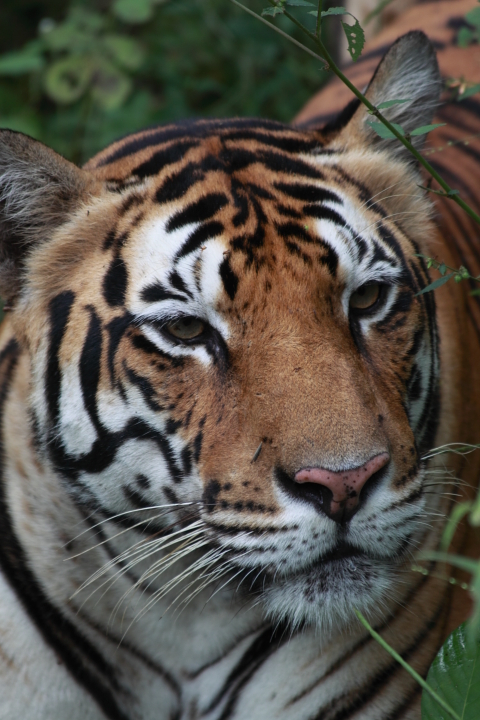
Showing posts with label Kanha National Park. Show all posts

Saturday, 6 April 2013

Tiger Wildlife Photography Tour Package


Shutterbug Nature Tour

5 Nights / 6 Days

 
Kanha Tiger Reserve is well known for its bio diversity, dense forests of Sal and Bamboo, Meadows and water bodies. It is famous for having a glimpse of the King of the Forest – Tiger and Jewel of Kanha - Hard Ground Barasingha, the twelve tined deer. Landscape falls in the path of migratory birds which is an added advantage for birders as more than 290 species of birds can be seen here. With 117 known Butterflies species, thousands of insects and other big and small one fill this bio diversity hot spot which is a nature lover’s paradise. Kanha National Park is known as paradise for wildlife photographers and nature lovers and some world famous photographers visit this natural heritage of India on regular basis.


Day 01

Kanha (L, D) Jungle walk: 1 Evening

Welcome on arrival at Kanha Village Eco Resort, Kanha National Park and check in at the resort. After an introduction session with lunch we take some rest before we go for our first Jungle walk for Bird watching in the buffer zone of Kanha National Park. We may also see Spotted Deer, Sambhar deer, Barking Deer, Foxes, Jackals, Hyena, etc., Around Dinner time we will have discussion / orientation session where we will discuss about the rich bio diversity of central India.


Day 02

Kanha (B, L, D), Safari: 1 Morning, 1 Evening

Morning safari drive in the national park will enable us to see those animals and birds which prefer dense forested areas and least human disturbance. Here we will be able to see the King – Tiger with other denizens of the jungle. Enjoy packed breakfast in the forest. After return from the park, freshen up, relax for an hour and have lunch.


Evening we go for our second safari in the core area where we will be able to see our flying friends and other animals like Sloth Bear, Spotted Deer, Dhole, Gaur, etc., Water bodies in the area are a big advantage for us as many animals and birds can be seen in the vicinity. Tiger, Leopard, Jungle cats and other carnivores prefer to move in the dusk preparing to make a kill and give us a chance to shoot them with our camera. At the resort we will discuss about taking better photographs and how to improve on our photography skills.


Day 03

Kanha (B, L, D), Safari: 1 Morning, 1 Evening

Morning and Evening safari drives in another zone with different habitation will enable us to see birds which prefer Meadows to dense forest areas. Here we will also get a chance to see Blue Bull, Hard Ground Barasingha, Sloth Bear, Tiger and Leopard along with other wild animals. Abundance of bird life along with mammals is an advantage and chances of clicking an award winning photograph always present so keep yourself forever ready with your gear as any moment lost means waiting for time unknown for same type of image. At night we will discuss about photographs taken and opportunities available after Dinner.


Day 04

Kanha (B, L, D), Safari: 1 Morning, Jungle walk: 1 Evening

Mornings in Kanha are always bit cold due to Sal forest and a drive in is always pleasing. With packed breakfast we go on open 4x4 Gypsy looking for the beautiful creations of God around the numerous water bodies and roads. Just keep your eyes open and remain on a watch for that perfect moment to capture. Evening we take a Jungle walk in the buffer zone on lookout of some of our feathered friends who prefer dusk time and other denizens of the forests.


Day 05

Kanha (B, L, D), Safari: 1 Morning, 1 Evening

Today we will have a morning safari at Kanha national park, yes, as you thought chances of seeing Tiger, Gaur, Sambhar, Barking deer and other small and big mammals is there. Remember patience and perfect understanding of wild animals is very important for any wildlife photographer.

Evening, keeping in mind those flying friends we have missed out and mammals which have been elusive till now we will and try to cover them all in our last safari of the tour.


Day 06

Kanha (B)

After a relaxed sleep we meet in the morning for breakfast at restaurant in the resort. Today is the end of present trip to Kanha and we leave for home with beautiful memories and stock of photographs of mammals and birds of central India.


Net Price per person: (On twin sharing basis)

For Indian Tourists:     Cottage: 22,299/-      Standard: 14,999/-

For Foreign Tourists:    (Ask for Special Rates)


·         Package is valid between:

§  Group 1: 19th May 2013 – 24th May 2013.

§  Group 2: 03rd June 2013 – 08th June 2013.

 
Check following link for further details:


Saturday, 6 August 2011

Tiger Safari in Madhya Pradesh

India is becoming a hot destination for wildlife watching safaris especially tiger safaris. Tourist and natural history photographers come from all over the world to visit national parks and tiger reserves in India to get a glimpse of striped cat – Tiger. These black and orange strips have been attracting people for hundreds of years. Be it seals found at Indus Saraswati civilization sites or in Indian folk lore Tiger has its own identity and now it has been given the honor of National Animal of India. Once India could boast of more than 40,000 of these striped cats roaming free in Indian forests but their number has decimated to less than around 1000 in last hundred years mainly due to game hunting, poaching and habitat destruction. To see this magnificent creature you have to visit tiger reserves in India with some of them having name internationally.

When the than US President Mr. Bill Clinton had visited India he had especially visited Ranthambhore national park to see this magnificent striped cat, the king of Indian jungles. Other famous names have visited national parks like Kanha, Bandhavgarh and others spread all over the country. Tourists visiting these national parks gets a chance of not only seeing a tiger in its home but also to enjoy the Indian forests and see other wild animals. India has 28 tiger reserves spread all over the country so deciding on one is very difficult.

Certainly if you are visiting a certain part of the country any nearby national park can be visited but if you are coming for Tiger safari I will any day recommend central Indian state of Madhya Pradesh which prides itself of 5 Tiger reserves and national parks including Kanha, Bandhavgarh, Pench, Panna and Satpuda having good tourist infrastructure. Now choosing any one here is again a very difficult task but I will recommend Kanha and Satpuda National parks of all since here you do not only get a chance to see the king of forests but the habitat is also very beautiful.

Kanha National Park is always my first choice because the sal and bamboo forests and grassland here have always attracted me the most and I enjoy being here like nowhere else. Most of my award winning photographs of wild animals has been clicked here. Being at Kanha gives me immense pleasure, people here are very good natured and well behaved and it is one of the best managed national parks in the country. Be it guides, gypsy owners or resort staff all are very happy to serve you and you never feel out of place. Their knowledge and detailed descriptive stories make you feel as if what they are narrating is happening with you and you can visualize everything as a movie.

Situated in Mandla and Balaghat districts of central Indian state of Madhya Pradesh Kanha national park is spread over 1940 Sq. Kms. with 940 Sq. Kms. being core and the rest as buffer. The main wildlife attraction here are Tiger, Hard Ground Barasingha, Gaur, Sambhar, Chital, Barking deer, Black buck, Sloth bear, Jackal, Fox, Porcupine, Jungle cat, Python, Pea fowl, Hare, Monkey, Mongoose and leopard amongst hundreds of other mammals, reptiles and insects.

The birds species in the park include Storks, Teals, Pintails, Pond herons, Egrets, Peacock, Pea fowl, Jungle fowl, Spur fowl, Partridges, Quails, Ring doves, Spotted parakeets, Green pigeons, Rock pigeons, Cuckoos, Rollers, Bee-eater, Hoopoes, Drongos, Warblers, Kingfishers, Woodpeckers, Finches, Orioles, Owls, and Fly catchers. It is winter destination for number of migratory birds who visit central India and winter stoppage for many who take rest while passing over to their final destinations in southern part of the country.

A conservation story worth telling is of a deer species which came back from the brink of extinction due to hard work and efforts of the forest department. Also known as ‘Jewel of Kanha’ and commonly known as Swamp deer or Barasingha, it was decimated to meager 66 number from which it has rebound and today Kanha national park has more than 350 of them. Seeing them in winters which is also there rutting season is one of the best time.

Kanha Tiger reserve has a well developed tourism infrastructure and is well connected with almost all major towns in central India like Jabalpur, Nagpur and Raipur. It has accommodation facilities which can serve the most elite to economy tourists. Tourists can stay at Taj safari’s Banjar Tola having luxury tented accommodation to Kanha Village Eco Resort (they were awarded Best Eco Tourism Initiative award recently) which has cottages made of clay and mud but with all modern amenities and required luxuries. Accommodations for economy to high end tourists are available here. Madhya Pradesh tourism and forest department also have properties which can be booked through them.

You need to book your safari which is in two parts, morning one takes off at around 5 and lasts for around 6 hours and evening one starts around 4 and is for 3 hours. Timing change as per season and sun rise and sun set so just check it with your hotel. These safaris can also be booked through your accommodation provider. In the morning you can also get a chance to see Tiger on elephant back, known as Tiger show, where the Mahouts try to locate tiger and ferry tourists to get a glimpse of the king.

When in Madhya Pradesh you can also do bird watching, try adventure activities, visit historical monuments and places with religious importance. See Indian culture and especially tribal culture which still remains unadulterated at many places. So, planning a trip to see Tigers in the wild, just don’t think, visit Kanha national park and I am very sure you will be very happy with your decision.

Thursday, 10 February 2011

Indian Wild Dogs - Dholes, the whistling predator

Indian Wild dogs - Dhole is one of the main carnivorous species found in Indian forests. A member of Canidae family of carnivores its scientific name is Cuon Alpinus. India has 3 sub-species of Dholes out of 10 found globally. It has more rounded ears and extremely high power of smell, hearing and sturdy set of legs. It has rich, reddish coat and a bushy black tipped tail with grey and white hairs.

 
Dholes live in social groups called clans with 5 to 20 members and they lead a highly structured social life. A wild dog has average weight of 18 kgs in males and 13 kgs in females. A female gives birth to 4 - 6 cubs after a gestation period of approximately 60 days. It breeds communally with most pack members helping to feed or guard the pups. They are also known as whistling hunters since they do not bark instead communicate by whistling, screaming or mewing.


Indian Wild Dogs are extremely successful hunters and their success rate is better than Tiger and other big cats since they attack on a prey in a group and in a very organized manner. The prey is pushed to exhaustion and ultimately surrenders or is chased by one party of the pack to an area where it is ambushed by another party which keeps a watch and waits for right moment. They start eating the kill immediately without waiting for it to die which is a sad part of the killing. Dholes prey upon the animals like chital, sambar, swamp deer, Indian hares, langurs and more and if they get a chance, they try to kill young of big animals like Gaur or Blue Bull.

 Dholes can easily be seen in Bhandavgarh, Bandipur, Kanha, Mudumalai, Melghat, and Periyar national parks and in isolated pockets in various parts of India.
Dholes are also known as whistling hunters


Indian Wild Dogs are very agile and work in a group

All photographs by Navneet Maheshwari, the author of this article. He can be contacted on nature.luv@gmail.com.

Navneet Maheshwari


Dholes are social animals - Photograph at Kanha National Park


India Wild Dogs - Dholes at Kanha National Park


Monday, 18 October 2010

Kanha National Park opened for new tourism season on 16th of October 2010. First day was really good for wildlife lovers with tiger sighting at four diffrent locations including tiger show. Here are photographs of Tigress I saw on first day on elephant back on tiger show.

As per information this year is going to be excellent in terms of tiger sighting especially since four tigress have cubs and by end of the year 2010 all these will start bringing their cubs out in open. I expect very good sighting from mid January onwards.

Although after the puja tourists had to face some unrest form Gypsy owner association who were opposing the new rules made by the forest department especially making taxi permit compulsory for all Gypsy's entring the tiger reserves core area and tourism zone. Mr. Mohanta, Deputy Director of Kanha Tiger Reserve gave permission allowing all gypsy's to enter the park but asked all gypsy owners to take taxi permit at the earliest. After entring the park the tourists got to see tigerss and other animals which made their day and most of them forgot about the delay caused in the morning.

Here are some photographs for all to enjoy.

Tiger at Kanha National Park

Tiger at Kanha National Park


Tiger at Kanha National Park


Tiger at Kanha Tiger  Reserve
Navneet Maheshwari

Wednesday, 11 August 2010

Gaur (Indian Bison) at Kanha National Park
Gaur also known as Indian Bison is found in Kanha National Park one of the most visited national parks of India. Tourists come here to see Tiger and other wildlife.

Monday, 26 July 2010

Kanha National Park - Introduction

Introduction


Tigress and Cub at Kanha National Park http://www.kanha.in/
Kanha – the heart of India’s effort to preserve the Tiger – the most majestic of the big cats, and, India’s national animal – is the best place to behold this gorgeous animal in its free, wild glory. Endangered Animals like the Tiger and the Hard ground Barasingha (‘the twelve-antlered’ or Swamp Deer) find a safe haven along with innumerable other animals, reptiles, birds and insects). The lush Sal & Bamboo forests and meadows inspired the creation of the unforgettable characters of Mowgli, Baloo the Bear, Sher Khan, Bagheera & others in Kipling’s Jungle Book.


Fantastic views from the Table-top of Bamani Dadar, the mythical Shravan Tal(of Ramayan fame), a look at the life of the simple tribal (the Baigas & the Gonds), a visit to the Madai Mela (village fair), nature walks, treks, picnics; and other than the Tiger and the Barasingha – the Indian Bison (Gaur), Sambar (the largest Indian antelope), Leopard, Sloth Bear, herds of Chital (spotted deer), Wild Dogs, Crested Serpent Eagle, and so many other animals, reptiles and birds are an unforgettable experience not just for an average tourist but also for the best photographers and naturalists.